How to Identify Quality Red Fish Roe
January 14, 2026
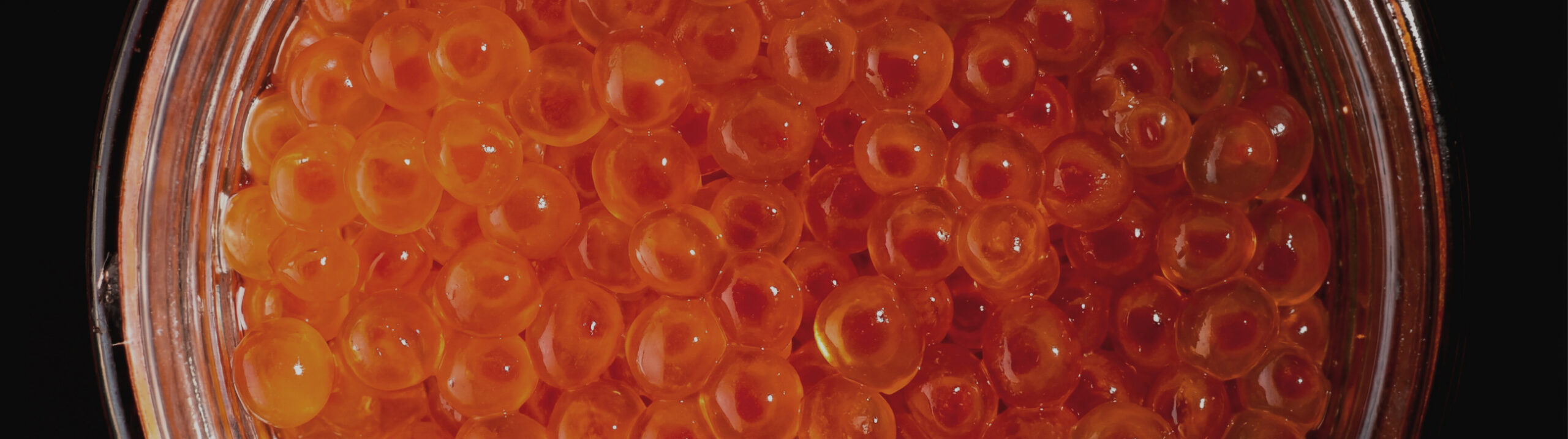
Fish roe is a product where quality differences are significant, but often not immediately visible to the eye. That is why it pays to know some basic principles that help determine whether you are dealing with a good, mediocre or questionable product.
At Kawiare, we believe that learning to recognise good food is part of enjoying it. The better a person understands what they eat, the clearer the difference between a random and a thoughtfully made product becomes. This knowledge does not make the experience more complicated, but frees it from unnecessary noise and the burden of myths.
The principles below help distinguish fish roe made with care and respect from that produced at the cost of compromises. These are not rules for buying, but guidelines for understanding taste and quality.
Appearance and Egg Uniformity
Quality fish roe eggs are uniform in size and shape. They are clearly distinguishable, not collapsed or crushed.
Good signs:
- eggs are separate
- surface is slightly glossy
- colour is natural and uniform
Bad signs:
- eggs are broken or flattened
- mass feels paste-like
- tone is unnaturally grey or dull
Smell
Salmon and trout roe should have a delicate, ocean-characteristic scent. If the fish roe smells strongly “fishy”, sour or metallic, this is a clear warning sign. Such odours indicate either poor raw material, incorrect processing or improper storage.
Fish roe must not be sour. Even very slight sourness indicates a decomposition process has already begun. The cause of such a defect may not be related to the quality of the raw material. Very often it is a problem stemming from non-sanitary production, insufficient hygiene or incorrect processing and storage conditions. Microorganism activity manifests itself precisely through a sour off-taste.
The flavour profile of quality fish roe is clean, clear and fresh. A sour note does not belong to the natural characteristics of fish roe and such a product should not be considered fit for consumption or presented as quality.
Taste and Texture
Good fish roe is not aggressive or sharp. The taste is clean, lightly salty and balanced. Texture in the mouth is an important quality indicator.
Fish roe quality is often described by how the eggs behave in the mouth. A common problem is a situation where the roe eggs do not yield to pressure from the palate and tongue but move around in the mouth. Quality caviar, on the other hand, responds to gentle pressure precisely and in a controlled manner.
The ideal egg, when pressed between the tongue and palate, opens gently and “bursts” in the mouth, releasing its flavour and texture.
Most common quality deviations:
- An egg that is too hard does not break under pressure and keeps moving in the mouth, leaving the taste experience incomplete.
- An egg that is too soft breaks before the right moment and loses its structure. In this case, we are no longer dealing with roe, but with liquid that does not carry the characteristic texture of fish roe.
- An egg that is too dry usually indicates improper storage. This can happen, for example, when an opened jar is left uncovered for too long or has been kept too long in an open fish counter, causing the fish roe to lose its natural moisture and elasticity.
This approach helps distinguish truly quality fish roe from a product that looks right but does not fulfil its purpose as a taste experience.
Saltiness
Salt should not dominate. Salt in fish roe is a preservative and an additive that supports natural flavours, not the main taste. Excessive saltiness often indicates that an attempt has been made to stabilise the product at the expense of taste. Quality fish roe uses salt minimally, with the aim of bringing out the character of the fish itself, not masking it. If masking occurs, it is not the fish’s own character being hidden, but poor raw material.
Composition and Additives
The composition of good fish roe is short and clear. It usually contains:
- fish roe
- salt
All added preservatives, colorants or stabilisers indicate compromises either in raw material or processing.
Origin and Traceability
For reliable fish roe, the origin is clearly stated. This means the species, farming or fishing region and producer. The more transparent the information, the greater the likelihood that the producer is not trying to hide anything. Vague origin or overly general labelling is always a risk. For example, labelling as “Origin EU” is usually not indicative of price/quality ratio in any way.
Want to learn more?
Explore articles about seafood origins, sustainable fishing, science, and longevity. Deepen your understanding of the ocean's treasures.

Caviar Without the Myths
Caviar is often treated as a luxury product or a festive table element. At the…
January 14, 2026

How to Identify High-Quality Octopus
Octopus is a seafood that creates many conflicting experiences. Some consider it a delicacy –…
January 14, 2026
Snow Crab is a Healthy, Sustainable and Delicately Flavoured Delicacy
Snow crab is a true world traveller, finding its way into traditional Japanese dishes as…
January 14, 2026